The myth of quick fluency — and what actually works
If you’ve been studying French for some time — trying different apps, reviewing vocabulary lists, listening to podcasts, buying textbooks, taking lessons here and there — you may have started with motivation and excitement… only to feel a growing sense of frustration.
You put in the effort.
And yet, you find yourself thinking:
“Why am I not improving, even after years?”
“I’ve taken several courses… but I still freeze in real conversation.”
“I’ve learned a lot of vocabulary, but I can’t actually use it.”
“When will I stop translating in my head?”
“French apps don’t seem to work — what am I missing?”
At that stage, many learners conclude they just haven’t found the right method.
So they begin looking for a radically different approach — one that promises fluent speech in three months. Exactly what you want to hear when you’re frustrated.
But French doesn’t work like that.
The good news is: you don’t need magic.
You need structure — because without structure, effort stays scattered, and studied knowledge never consolidates into usable language.

Why Effort Doesn’t Automatically Lead to Fluency
Most adult learners are very motivated and work hard.
But effort alone does not guarantee consolidation.
Language acquisition is not built on isolated activities.
It is built on cumulative exposure.
When learning is fragmented — an app here, a lesson there, a podcast when you have time — the brain doesn’t receive enough structured repetition to stabilize patterns.
You may recognize words that you read.
You may understand explanations.
You may even complete exercises correctly.
But recognition is not the same as retrieval.
And retrieval is not yet automatic use.
Without structure:
✺ Vocabulary remains passive
✺ Grammar stays theoretical
✺ Comprehension improves faster than speaking
✺ Confidence fluctuates
Fluency develops when exposure, repetition, and use are organized so that each layer reinforces the previous one.
That is what most learners are missing — not effort, not talent, but structured progression.
The Real Limitation Is Exposure — and Interaction
When learners feel stuck, many begin to question their ability.
Maybe they are not “good at languages.”
Maybe they started too late.
Maybe others simply have more talent.
After teaching adults for more than a decade, I can say something very clearly:
Those explanations are rarely the real issue.
Most adult learners are perfectly capable of learning French.
What usually limits progress is something much simpler.
The language does not appear often enough in their life.
One hour of French per week — surrounded by an entire week lived in English — gives the brain very little opportunity to stabilize patterns.
You may understand explanations during the lesson.
But if the language disappears for the next six days, much of that fragile structure fades before it can consolidate.
Language acquisition depends heavily on frequency of contact with the language.
Not only studying it.
Reading it.
Hearing it.
And especially speaking it with someone who can respond, correct, and guide you.
In many ways, language works like physical training.
Going to the gym once a week and then remaining inactive for the next six days rarely produces visible change.
The body needs regular stimulation to build strength.
The brain works in a similar way with language: it needs repeated contact with patterns before they stabilize.
The Grammar Debate: Why Both Extremes Miss the Point
If you search online for advice about learning languages, you will quickly encounter two opposite claims.
Some people argue that grammar is unnecessary and that exposure alone is enough.
Others focus heavily on rules and explanations.
Both perspectives capture part of the picture — but neither tells the whole story.
Without a grammatical foundation, reading quickly becomes limited.
You may recognize individual words, but understanding how sentences are structured becomes difficult.
At the same time, grammar explanations alone do not create fluency.
A rule understood but never reused tends to fade quickly.
It is a bit like reading the instructions for a musical instrument without ever playing it: the explanation may make sense in the moment, but the skill never develops.
So grammar is not the goal of language learning.
But in a language like French — where agreement, verb forms, and sentence structure shape meaning — avoiding grammar entirely quickly creates limits.
It becomes difficult to expand reading, express more complex ideas, or speak with real flexibility.
What tends to help most is approaching grammar progressively: learning just enough structure to support your progression, so that reading, speaking, and understanding can expand naturally over time.
What Real Progress Actually Looks Like
One reason many learners feel discouraged is simply that progress rarely looks the way they expect.
Language acquisition is gradual.
In the early months, much of the work happens beneath the surface.
You begin building pronunciation habits.
You start recognizing common sentence structures.
You form simple sentences with guidance.
Your brain is slowly organizing sounds, patterns, and meanings into systems that will later become easier to access.
At this stage, the effort often feels disproportionate to the visible results.
You are still hesitating when you speak.
You still need to translate in your head.
You still struggle to understand native speakers in most situations.
But this does not mean nothing is happening.
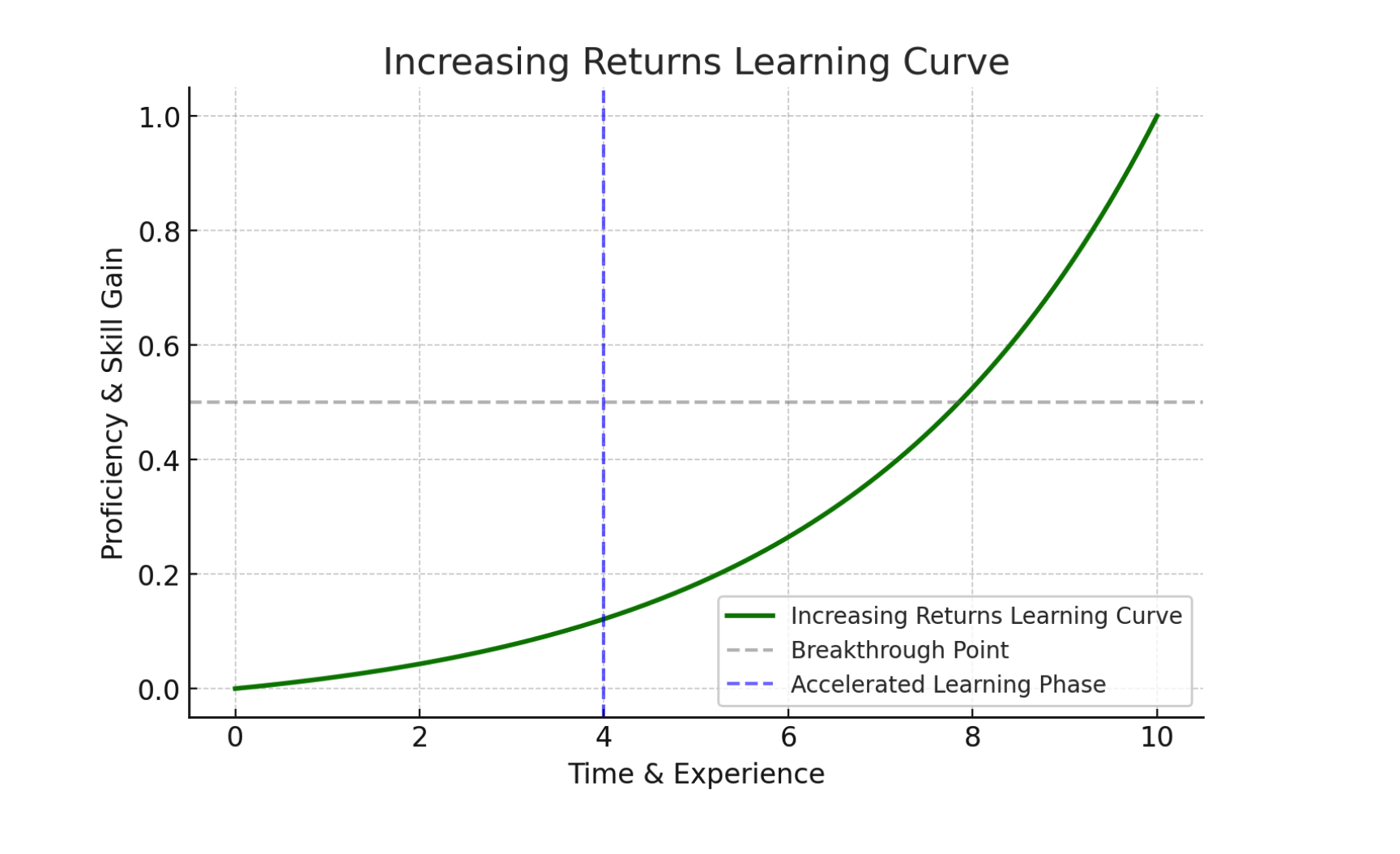
In many areas of learning, this pattern is sometimes described as the increasing Returns Learning curve.
For a long time, effort seems to produce very little visible progress. The result is that many learners quit at the breakthrough point, just before results appear. But in reality, during that period, the underlying structures are quietly forming.
Then, at some point, improvement becomes more noticeable — and progress finally begins to accelerate with less and less effort. Understanding this pattern changes how you interpret your own progress.
Instead of assuming nothing is working, you begin to recognize that the foundations are still being built.
And when those foundations finally stabilize, the language starts responding.
You start understanding more and more of what French speakers say.
You can follow conversations for longer without losing the thread.
And you begin to speak or write at times without translating first.
That is often the moment when learners realize:
the effort was never wasted — it was simply preparing the ground.
The Learning–Forgetting Cycle
Many adult learners follow a pattern that feels productive but rarely leads to lasting progress.
They learn new vocabulary.
They study a grammatical rule.
They complete exercises.
Then they move on to the next lesson.
A few weeks later, much of what they learned earlier has already faded.
And a few months later, they may have forgotten most of it — sometimes almost everything.
Research on memory has shown how quickly new information disappears when it is not reused.
So learners often find themselves studying the same vocabulary again, revisiting the same lessons, and wondering why their memory seems so unreliable.
But the issue is rarely their memory.
The problem is that most learners are never shown how studied knowledge gradually turns into usable language.
Vocabulary, grammar, and exercises are useful — but only if they are reused often enough for the brain to stabilize them.
Without that repeated reuse, new information remains fragile.
It is understood for a moment, practiced briefly, and then slowly replaced as new material appears.
Fluency begins to develop only when knowledge stops being something you briefly learn and move past — and starts becoming something you reuse, revisit, and encounter again and again.
That repeated contact is what allows patterns to settle and eventually become natural.
What Actually Helps Knowledge Stabilize
If new knowledge disappears quickly when it is not reused, the opposite is also true.
When the same elements appear again and again in slightly different situations, the brain begins to stabilize them.
A word encountered once is fragile.
A word encountered repeatedly in reading, conversation, and listening begins to feel familiar.
A grammatical structure explained once may remain abstract.
But when that same structure appears again in sentences you read, hear, and try to produce, it gradually becomes easier to recognize and reuse.
This is how patterns slowly move from effortful thinking to more automatic use.
Fluency does not appear because a rule has been memorized.
It develops when the language begins appearing often enough for the brain to recognize those patterns without needing to reconstruct them every time.
In other words, stability comes from repeated contact with the same elements over time.
And that is what eventually allows the language to become more quickly accessible.
One Factor That Changes Everything: Frequency
If language patterns stabilize through repeated contact, one factor becomes particularly important: frequency.
The more regularly the brain encounters the language, the easier it becomes for patterns to settle.
With only one lesson per week, for some students, progress can remain fragile.
New elements appear, but by the time the next lesson arrives, part of that knowledge has already begun to fade.
For many beginners, two lessons per week with a tutor often make a significant difference.
The same patterns reappear before they vanish, enabling the brain to strengthen them instead of recreating them each time.
Instead of constantly relearning fragile knowledge, learners begin encountering the same structures often enough for them to stabilize.
The result is not only that progress becomes more visible — it accelerates.
Once that stage is reached, the language no longer exists only during class time — it begins appearing more naturally in reading, listening, and everyday interactions.
And that is when progress tends to become both more stable and more rewarding.
Starting to Use French in Daily Life
At some point, progress begins to depend less on how much you study and more on how often the language appears in your life.
For many learners, French initially exists only in a learning context: during lessons, exercises, or review sessions.
But as patterns begin to stabilize, the language can slowly start appearing outside those moments.
Short texts become more accessible.
Conversations become easier to follow for longer periods.
Certain expressions begin to feel familiar.
This does not happen because the language has been fully mastered.
It happens because the brain has encountered the same patterns often enough for them to start becoming recognizable.
From that point on, learning no longer relies only on structured lessons.
For learners preparing to live in France, this stage often becomes especially important. If that is your situation, you can read more about my French coaching for Americans preparing for life in France.
The language begins to appear in everyday situations — through reading, listening, or interaction.
And that gradual integration often marks an important shift in the learning process.
French is no longer only something being studied.
It is starting to become something that can be used.
Who This Approach Is For
The good news is that learning French as an adult is absolutely possible.
But real progress rarely comes from a “miracle method” or a “new app”.
It comes from creating the conditions for gradual automaticity — through repeated exposure, meaningful interaction, and regular contact with the language.
As a tutor, this is the kind of work I focus on with my students.
Not shortcuts.
Not quick promises.
But helping the language stabilize over time so that it becomes something you can actually use — and gradually integrate into your life.
This approach is for adults who want to build durable fluency — not jump endlessly from one new method to another in search of faster results.
For them, the goal is not simply to learn French for an exam or another short-term goal.
It is to develop real fluency — the kind that continues to grow organically outside the lessons themselves.
And beyond the effort, learning French often becomes something deeply rewarding — opening doors to new conversations, new perspectives, and experiences that would otherwise remain out of reach.
Because in the end, fluency is not something you achieve once and for all.
It is something you grow into.
If you feel like your French hasn’t been improving despite your efforts, it may not be a question of motivation — but of how the language is actually learned and practiced.
You can start here: Explore my French tutoring approach